Saturday, September 22, 2012

Growing on a Ledge

Every spring my husband, Chris, plants a garden, and every spring I give a little moan.  Thirteen years ago we fell in love with our home on a hill in Upton MA.  Each May, I watch as my husband kills himself turning the soil on this 5 acre ledge.
His excitement about the planting season is infectious.  He starts planning his seed selection as early as Christmas.  Of course, tomatoes are his love.  We debate how many plants to buy.  I think 10 are plenty, but we settle on 20 only to find  40 more on planting day.  One year he planted 80 tomato plants.  I thought he was going to blow an artery digging into the hardpan.  
Every year we kept prospecting for different garden locations: on the hillside, the front lawn, behind the house, behind the barn – the sheep ate all the tomatoes that year.
After many disappointing growing seasons, I suggested joining a CSA or community garden.   His reply would always be, “Why do we need to go somewhere else to garden”?  This answer would frustrate me, and only recently did I understand why.
 
We grew up watching our grandparents and our parents growing their gardens.  The saying, it’s in your blood, sort of holds true.  For Chris, his garden belongs in the backyard around family.  
I delivered my husband a blow when I announced, last fall, I wanted to build a riding arena in the spot where he planted his struggling garden.  "We're going to hit ledge", he said, as he tried to defend his anemic tomatoes.  As his anxiety mounted, I reassured him the arena was a practical use of the space, considering we have the horses.  So, we flattened the garden, took down some trees, and the arena was born.   Amazingly, we didn't hit ledge, what we did find was lots and lots of rocks. 

The piles of stone were put to good use, this spring, when Chris built a wall around the arena and back filled the edges with compost, making a terraced garden.  We planted Hubbard squash, zucchini, gourds, and nasturtium.  Near the barn we planted beans, cucumbers, tomatoes, and beets.


As the growing season draws to a close, I give a sigh of  relief, the garden was a success!  The combination of good compost and new found sunlight, made all the difference. Everything we planted produced like never before.  We had zucchini and cucumbers coming out of our ears. Except for Mr. Groundhog nibbling on the tomatoes, everything flourished.  Sometimes, success comes when you least expect it.  Even though we didn't plan combining the arena and garden, it turned out to be a win-win.  I guess you can have your cake and eat it too, or in our case, your cuke and eat it too.

Joy! :)

- Trish


Wednesday, September 19, 2012

Pippi's Fleece

I’m crazy about wool!   I love touching, feeling, and caressing its silkiness.  I even love the smell; the lanolin makes me feel more connected to the earth.  Growing up, I remember how special it was getting that new wool coat. 

My appreciation only grew when I started to spin wool.  Every breed creates its own 
unique fiber.  Some are short and springy, others are long and curly. 

Boarder Leicester wool


 Romney/Merino mix wool


Finnish Landrace wool

When I realized every wool spins a different yarn - no pun intended- I became a wool addict, scouring fiber festivals.   In every booth I saw fleeces waiting for me to make into beautiful and unique yarns.  Boarder Leicester and Romney sheep produce some of my favorite fibers, but to my surprise the best wool came from a ewe living right in my own backyard.

Pippi's fleece

We had an old soapstone sink left on our property.    Some of our friends were remodeling their farm house.  So we traded the sink for Pippi, a Finnish Landrace ewe.   I was happy to get rid of the sink and they were happy to get rid of their ewe.

If Mary's sheep was as white as snow, Pippi's fleece was as black as coal.   Sheep, like people, can grow old and gray, and with every passing year Pippi's fleece lighten into the beautiful soft shade of silver it is now.
Pippi on left in 2004  


Pippi in 2006

Pippi in 2012

I treasure Pippi's fleece every year.  I love spinning, knitting and weaving with it.
As I was putting some woolens in the cedar chest that no longer fit the children, I noticed the color change with every sweater and scarf, and smiled knowing that Pippi's fleece has helped mark the passage of time.

Nola Fournier's  book "In Sheep's Clothing"  is a great handbook of different breeds and wool characteristics.

- Trish

Sunday, September 9, 2012

Saucy Summer

There is nothing like the sweet taste of summer tomatoes.  But finding that flavor out of season is a trick to be sure.  One of our favorite ways to capture the taste of summer is to make sauce.  Making your own sauce is as easy as 1-2-3.


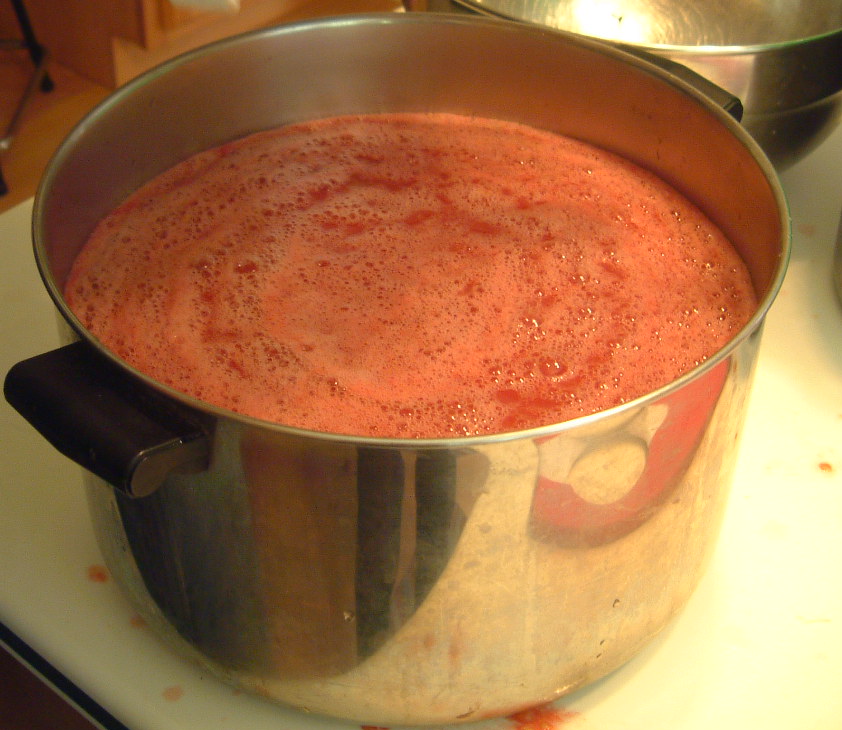
We start out crushing and grinding about 40 medium sized tomatoes.  This is a whole lot of work so you might want to ask someone to help you.


As you can see we're not picky about whom we recruit.


Tomatoes crushed and ground we're ready to simmer down.  There is so much water in the tomato puree we need to reduce down to half.  We add a little olive oil, lots and lots of fresh basil, crushed garlic, oregano, salt, and pepper. 


Sauce after about 3 hours of simmering on stove - yum!  Now we are ready to eat.


Dad and the kids opted for their sauce over penne.


A little pecorino romano cheese is a must.


Mom decided to have her sauce mixed with chick peas and zucchini.


We'll freeze the extra sauce so in winter we can have a taste of summer.

Bon Appetit!


Now what do we do with all these zucs and cukes?  Any ideas?

- Chris